



Content Head and Video Creator, FirstLease
How Generative AI is Redefining CRE’s Future in 2026?
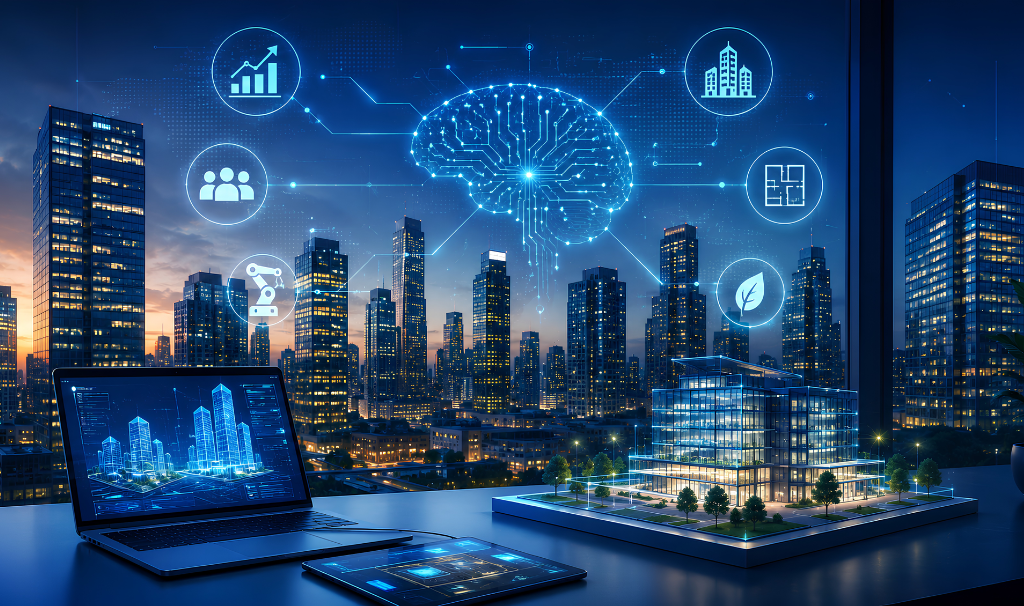
Commercial real estate has always evolved with technology - from digital property platforms to smart buildings and data-driven decision-making. However, Generative AI in Commercial Real Estate is bringing a deeper transformation by changing how businesses discover, design, manage, and optimize workspaces.
In 2026, AI-powered solutions are becoming a strategic advantage for developers, investors, landlords, and occupiers. Generative AI can analyze massive amounts of market data, predict demand patterns, automate property operations, create workplace designs, and help businesses make faster and smarter real estate decisions.
Unlike traditional technologies that simply process information, Generative AI technologies can create new insights, recommendations, designs, reports, and strategies by learning from existing data. This capability is helping CRE professionals move from reactive decision-making to proactive planning.
As businesses demand smarter workplaces, flexible office environments, and data-backed real estate strategies, AI is emerging as one of the biggest drivers shaping the future of commercial real estate in 2026.
What Is Generative AI?
Generative AI is a branch of artificial intelligence that enables machines to create new content, insights, and solutions by analyzing existing information. It uses advanced technologies such as large language models machine learning, and deep learning to generate text, images, designs, predictions, and recommendations.
While traditional AI focuses mainly on analyzing data and identifying patterns, Generative AI creates new outputs based on learned information.
For businesses, this means AI can:
- Generate detailed market reports
- Analyze customer and tenant preferences
- Create workplace layouts
- Automate business communication
- Predict real estate trends
- Improve operational efficiency
In the CRE sector, AI in property is helping companies improve everything from property searches and investment analysis to workspace design and facility management.
Why Generative AI Matters for Commercial Real Estate?
The commercial real estate industry depends heavily on accurate information, market timing, and strategic decisions. With changing workplace preferences, hybrid work models, and increasing demand for personalized spaces, traditional approaches are no longer enough.
Enterprise AI use cases are helping CRE organizations unlock new opportunities by improving:
1. Smarter Property Decision-Making
AI can analyze:
- Rental trends
- Location performance
- Tenant demand
- Market fluctuations
- Investment opportunities
This allows businesses to make data-driven decisions instead of relying only on historical information.
2. Faster Workplace Planning
Modern companies require offices that support collaboration, productivity, and employee well-being. AI-powered workplace solutions can analyze employee patterns and recommend optimized layouts, seating arrangements, and workspace designs.
3. Improved Customer Experience
AI enables personalized property recommendations by understanding business requirements such as:
- Team size
- Budget
- Location preference
- Growth plans
- Workplace requirements
This creates a more efficient property discovery experience.
Key Generative AI Use Cases in Commercial Real Estate:-
1. AI-Powered Property Search and Recommendations
Finding the right office space requires analyzing multiple factors. Generative AI can process thousands of property data points and recommend spaces that match specific business needs.
Businesses can receive recommendations based on:
- Location advantages
- Connectivity
- Amenities
- Pricing
- Future expansion possibilities
This reduces search time and improves decision-making.
2. AI in Commercial Real Estate Market Analysis
Market intelligence plays a crucial role in CRE investment and leasing decisions.
With AI use case examples, companies can use AI to:
- Predict rental trends
- Identify emerging business hubs
- Analyze demand patterns
- Forecast market growth
AI-driven analytics help investors and businesses understand opportunities before market changes occur.
3. Generative AI in Office Design and Fit-Out Planning
The workplace of the future requires flexibility and innovation.
AI in design process is transforming office planning by helping designers create:
- Space-efficient layouts
- Employee-focused environments
- Sustainable workplace concepts
- Smart office designs
AI can generate multiple workplace concepts based on company culture, employee requirements, and operational goals.
4. Smart Building Management
Buildings are becoming more intelligent with AI integration.
AI-powered technology helps manage:
- Energy consumption
- Maintenance schedules
- Security systems
- Occupancy monitoring
- Building performance
Predictive maintenance powered by AI reduces downtime and improves asset value.
5. AI for Real Estate Investment and Asset Management
Investors are using artificial intelligence asset management solutions to evaluate properties more effectively.
AI helps with:
- Risk assessment
- Portfolio analysis
- Financial forecasting
- Asset performance tracking
This allows investors to make stronger decisions with real-time insights.
Benefits of Generative AI for CRE Businesses: -
- Increased Efficiency- Automation reduces time spent on repetitive tasks such as reporting, documentation, and market research.
- Better Decision-Making- AI provides accurate insights by analyzing large volumes of real estate data.
- Cost Optimization- Businesses can identify operational inefficiencies and improve resource utilization.
- Personalized Experiences- AI enables customized property recommendations and workplace strategies.
- Competitive Advantage- Companies adopting AI early can respond faster to changing market conditions.
How AI Is Transforming the Future of Commercial Real Estate in 2026?
The future of CRE will be shaped by intelligent systems that combine human expertise with AI capabilities.
Some emerging AI future trends include:
- AI-Powered Predictive Analytics- AI will help businesses forecast demand, pricing, and investment opportunities.
- Personalized Workplace Experiences- AI will create offices that adapt to employee needs and working styles.
- Autonomous AI Agents- Next-generation AI systems will independently perform tasks such as market research, reporting, and operational management.
- Sustainable Real Estate Solutions- AI will support energy efficiency, carbon reduction, and green building strategies.
Challenges of Implementing AI in CRE:-
While AI-driven business models offer significant opportunities, businesses must also address challenges such as:
- Data Security- CRE companies must ensure sensitive property and customer data remains protected.
- Integration Challenges- AI systems need to integrate smoothly with existing real estate platforms.
- Workforce Adaptation- Employees need proper training to effectively use AI tools.
- Responsible AI Usage- Businesses must maintain transparency and ethical AI practices.
The Future of Generative AI in Commercial Real Estate
Generative AI is not replacing real estate professionals; it is enhancing their capabilities. The combination of human expertise and artificial intelligence will create a more efficient, intelligent, and customer-focused CRE ecosystem.
From smarter leasing decisions to advanced workplace planning, Generative AI technologies will continue reshaping how businesses interact with commercial spaces.
Companies that embrace AI-powered solutions today will be better positioned to create flexible, data-driven, and future-ready workplaces.
Conclusion
The integration of Generative AI in Commercial Real Estate marks a significant shift in how businesses approach workspace planning, property decisions, and market strategies. AI is enabling faster analysis, smarter recommendations, improved efficiency, and innovative workplace solutions.
At FirstLease, we believe the future of commercial real estate will be driven by a combination of technology, expertise, and human understanding. By combining market knowledge with modern digital solutions, FirstLease helps businesses identify efficient, future-ready office spaces that support their growth and long-term goals.
As AI continues to evolve, businesses that adopt intelligent real estate strategies will gain a stronger advantage in the changing CRE landscape of 2026 and beyond.
Frequently Asked Questions (FAQs)
1. How is Generative AI transforming commercial real estate?
Generative AI transforms CRE by improving property searches, market analysis, workplace design, investment decisions, and building management through data-driven insights.
2. What are the benefits of AI-powered solutions in real estate?
AI-powered solutions help businesses reduce costs, improve decision-making, automate processes, personalize experiences, and optimize property operations.
3. How can AI help with office space planning?
AI can analyze employee requirements, workspace usage patterns, and business goals to create optimized office layouts and smarter workplace designs.
4. What are the biggest AI trends in commercial real estate for 2026?
Major trends include predictive analytics, smart buildings, AI-driven workplace solutions, automated property management, and personalized real estate experiences.
5. Will AI replace commercial real estate professionals?
No. AI will support CRE professionals by automating repetitive tasks and providing better insights, while human expertise remains essential for negotiations, strategy, and relationship management.